Legal Insights
Civil vs. Criminal Cases: Understanding the Key Differences
By Advocate Dr. Vishnu Sharma • 17/9/2026
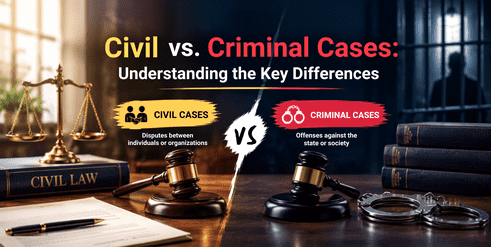
Understand the key differences between civil and criminal cases in India, including their purpose, procedures, burden of proof, penalties, and legal remedies.
Civil vs. Criminal Cases: Understanding the Key Differences
If you've ever been on the edge of your seat during a courtroom scene in a movie or been caught up in a strange legal situation yourself, you've probably heard about a "civil case" and a "criminal case," and wondered what the difference was. Sure, there's often a lot of confusion in casual conversation, but in the law, the difference couldn't be starker. Take a closer look at these two types of cases.
The Core Purpose: Punishment vs. Resolution
The key differentiator of civil and criminal law is really why does the case exist in the first place.
Criminal cases are created to punishes behavior the community has determined through its laws to be hurtful to others. Crimes such as theft, assault, or fraud aren't simply offenses committed against the individual victim. They are also offenses committed against the state and the public order – which is why the government brings criminal cases, not the victims.
The difference between Criminal Cases and Civil Cases Civil cases, as opposed to criminal cases are disputes between one private party and the another. Civil cases serve to settle disputes between two private parties – which can be individual citizens, corporations, or other organizations – and recover damages, otherwise known as money, for the wrong committed.
Who Brings the Case?
In a criminal matter, the government (represented by a district attorney, prosecutor, or other official) initiates the proceedings by alleging the defendant committed a crime. We refer to this as the "defendant" and the "accused." There is usually not technically a party to the case that the victim is involved with, but their testimony is often key to the case, and if the victim testifies, they will usually be referred to as the complainant.
It is usually styled something like "The State v.
Smith" or "United States v.
Smith."
In a civil lawsuit, a private person or business known as the "plaintiff" sues another person or business, known as the "defendant," to recover damages or some other remedy. The lawsuit may be titled something like "Smith v. Jones" or "Doe v. XYZ Corporation."
The Burden of Proof
This is arguably the most common -- and most commonly misunderstood -- difference between the two systems.
The burden of proof for a criminal case is "beyond a reasonable doubt." This is the most stringent standard in the courts because a defendant could face loss of liberty if found guilty. If any real doubt exists, the person should be cleared of the crime.
In civil cases, the bar is much more forgiving - it's called the "preponderance of the evidence." This can be summarized as "more likely than not" (in practice, more than 50% probable) that the accused is guilty - lower even than probable cause for arrest, which is typically summed up as 51%. That's why you can sometimes be found not guilty criminally but still held liable civilly in the same case.
The most well known example is O.J.
Simpson.
Possible Outcomes
There are many differences between the gravity and weight systems. The potential results and risks are all drastically different.
Criminal cases can lead to:
- Imprisonment
- Probation
- Fines paid to the government
- Community service
- In the most serious cases, death penalty (if allowable)
Civil cases typically result in:
- Monetary damages paid to the plaintiff
- Injunctions (court orders to do or not do something)
- That the contract is specific performance (another party being ordered to perform a contractual obligation)
- Declaratory judgements (a court statement of the legal rights of the parties)
Specifically, no civil case will land you in jail – no one has spent time in the clink solely because they lost a civil case (though some court orders can in the proper circumstances be held to be contempt of court).
Constitutional Protections
Since criminal cases involve the potential loss of one's liberty, defendants in a criminal matter have an array of constitutional rights not afforded to litigants in a civil case. These are the right to a court-appointed lawyer, if the defendant cannot afford one; the right to be free from self-incrimination; double jeopardy; and the right to a speedy and public trial by an impartial jury.
There is less built-in protection for civil defendants. They typically must retain and pay their own attorneys and do not have the "double jeopardy" protection to count on - the same conduct can sometimes support multiple civil lawsuits.
How the Same Action Can Result in Both.
Yes. One action can result in both criminal and civil cases being filed at the same time. Criminal cases have a different purpose than civil cases and are prosecuted independently, so any one act can trigger both a civil and criminal case against the defendant (for example, an assault or shooting victim could face a criminal case from the state and a separate civil case from the victim to recover damages for medical expenses, wages lost, pain and suffering, etc).
Why This Distinction Matters
Knowing if a matter is civil or criminal clarifies your expectations for what is really on the line, what kind of evidence counts and what type of legal help you require. It also accounts for why it's so easy to get confused by media coverage of a legal dispute – the same facts and circumstances are likely occurring in two very different courtrooms with two very different rules.
In conclusion, we all know that these two systems exist independently but at the end of the day, they must both work to serve the same purpose. Crime law is the protection of the society and civil law is the individual taking the case of crime law.